Posts

Showing posts with the label Evaluating Expression

Nested if and Multi-Way if-else Statements
Image
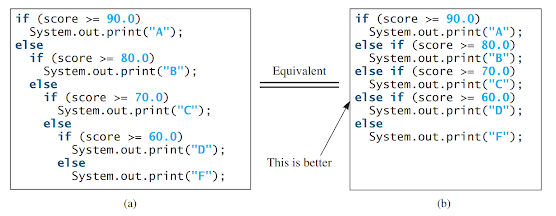
Nested if and Multi-Way if-else Statements:           An if statement can be nested inside another if statement, forming a nested if statement. This allows for more complex decision-making in a program.           In a nested if statement, an if statement is placed inside another if statement. The inner if statement is considered to be nested within the outer if statement. There is no limit to the depth of nesting and an inner if statement can also contain another if statement.           Here is an example of a nested if statement: if (i > k) {     if (j > k)         System.out.println("i and j are greater than k"); } else {     System.out.println("i is less than or equal to k"); }           In this example, the inner if statement ` if (j > k) ` is nested inside the outer if statement ` if (i > k) `. This allows for di...

Evaluating Expressions and operator Precedence

Image
 Evaluating Expressions and operator Precedence:           Java expressions follow the same evaluation rules as arithmetic expressions. When writing a numeric expression in Java, you can directly translate the arithmetic expression using Java operators.           For example, consider the arithmetic expression: (3 + 4x /5 )- (10(y - 5)(a + b + c) / x) + 9((4/x) + (9 + x)y)            This can be translated into a Java expression as: (3 + 4 * x) / 5 - 10 * (y - 5) * (a + b + c) / x + 9 * (4 / x + (9 + x) / y)           While Java has its own internal mechanism for evaluating expressions, the result of a Java expression and its corresponding arithmetic expression is the same. Therefore, you can safely apply the arithmetic rules for evaluating a Java expression. Operators enclosed within parentheses are evaluated first, and nested parentheses are evaluated from ...

Popular posts from this blog

Named constants and naming conventions

Nested if and Multi-Way if-else Statements

Numeric Data Types , Operations and Literals